Raye's 10,000 Hours
Malcolm Gladwell once wrote that mastery takes 10,000 hours. Ten thousand hours of deliberate practice, failure, repetition, and relentless dedication before greatness becomes possible. (Here’s a recent video expaining what he really meant.) It's a theory that has inspired millions — but rarely does it play out quite so publicly, quite so painfully, and ultimately quite so triumphantly as it has in the life of one South London singer called Raye.
Rent-a-Vocal
Rachel Agatha Keen (as she is known to her family) wrote her first song at age eight. Performed it at Southwark Cathedral after her father taught her to play the piano. By fourteen, she was accepted into the prestigious BRIT School — and by seventeen, she quit because she felt limited. By then, she had independently uploaded her debut EP to SoundCloud. Olly Alexander, then frontman of Years & Years, stumbled across a track called "Hotbox" and passed it to his label. That label was Polydor Records. And that's where the story gets complicated. Polydor saw something in Raye. They signed her to a four-album deal in 2014. What they didn't do — for seven years — was let her make a single one of those albums.
Instead, she was put to work writing hits for other people. Songs for Beyoncé. Songs for Charli XCX. Songs for Rihanna and John Legend. She was, in her own words, a "rent-a-vocal" — a featured voice on club tracks by Jonas Blue, Jax Jones, David Guetta, Joel Corry. Chart placements, yes. A career of her own? Not even close. The label kept moving the goalposts, insisting her singles needed to hit certain streaming numbers before they'd release the funds for an album. Numbers that were never written into any contract. Numbers that could change at any time. A trap with no visible door.
In June 2021, she'd had enough. She took to Twitter and wrote a message that shook the music industry:
Imagine this pain. I have been signed to a major label since 2014 and I have had album on album of music sat in folders collecting dust.
She was, she said, giving away her songs to A-list artists because she was still "awaiting confirmation that she was good enough to release an album." The post went viral. The support from fellow artists was immediate and overwhelming. Within weeks, Polydor released her from her contract.
Here is where Gladwell's theory becomes more than just a motivational idea. Because those ten thousand hours — the years of writing, recording, adapting, being told no, being redirected, watching other artists succeed with music she'd created — didn't disappear. They accumulated. They sharpened her. Every frustration became craft. Every compromise she'd been forced to make in someone else's direction became a lesson in knowing exactly what her direction was.
When Raye finally released My 21st Century Blues in February 2023 as a fully independent artist — managed by her own parents, who had quit their jobs to back her — it was an album that could only have been made by someone who had survived exactly what she had survived. Big band jazz, gospel, boom bap, blues, R&B — a kaleidoscope of everything she'd ever absorbed, shaped into something entirely her own. The industry that had suppressed her handed her the very depth that made the album extraordinary.
My 21st Century Blues peaked at number two on the UK Albums Chart. "Escapism" went viral on TikTok and became her first number one. Then came the 2024 BRIT Awards — where Raye walked away with six trophies in a single night, a record-breaking sweep that included Album of the Year, Artist of the Year, and Songwriter of the Year. Six BRITs. Independently. Without a major label. Against all the artists the industry had chosen to back instead of her.
This Music May Contain Hope
And now, just last Friday — March 27, 2026 — she released This Music May Contain Hope. It is, to put it simply, a masterpiece in the making of a mature artist who knows exactly who she is.
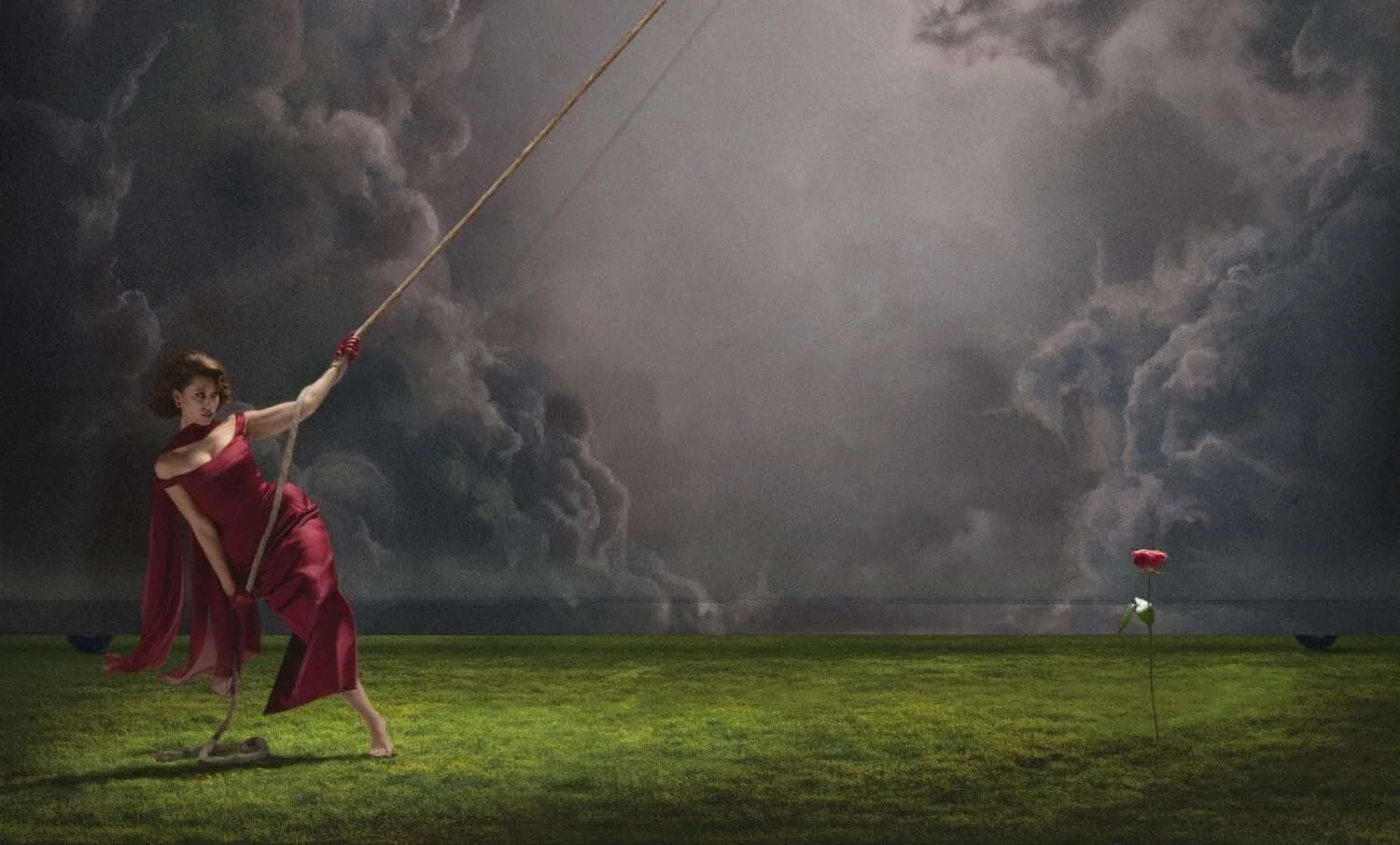
Structured across four "seasons," the album takes listeners from darkness to light — from the haunted opening of "Girl Under the Grey Cloud" through winter storms and personal aches, past a gut-punch collaboration with the legendary Al Green on "Goodbye Henry," a Hans Zimmer-assisted centrepiece in "Click Clack Symphony," and finally into the warmth of summer: joy, healing, and a cheeky global smash called "Where Is My Husband!" The album ends with "Fin." — a full stop that feels earned.
The critics have taken notice. Metacritic rates it at 90 out of 100, earning universal acclaim. But what makes this album more than a collection of brilliant songs is its emotional architecture. Raye has described it as "medicine I'm making for myself that I can share with the world." Listening to it, you believe her. Every note feels intentional. Every lyric carries weight. This is not an artist trying to prove something to an industry that doubted her. This is an artist who has moved beyond that entirely — someone writing from a place of genuine power, genuine freedom, and genuine hope.
Malcolm Gladwell's 10,000 hours theory was never really about practice for its own sake. It was about the transformation that happens when you commit so deeply to something that you become inseparable from it. When the skill stops being something you do and starts being something you are.
Raye's hours didn't just happen in studios. They happened in frustration, in grief, in silence, in the quiet act of continuing to create when the world — or at least the industry — wasn't ready to listen. They happened in the songs she wrote for other people that never carried her name. They happened in the tears behind the scenes and the strength it took to finally say, publicly: enough.
The result is an artist who doesn't just sing songs. She builds worlds. She tells truths. She makes you feel less alone.
This Music May Contain Hope is finally out. Play it loud. Play it from the beginning. And by the time you reach "Fin.", you'll understand — the best things really do take 10,000 hours.